Sharp jawline — the taper of the outline, and why "sharp" has no number
The word describes a photograph: an edge with contrast, under a light, in focus. What a front photo can hand you is the geometry underneath it — how fast the outline comes in, and how hard it turns at the corner. This page measures the first of those two.
Sharpness belongs to an edge: how far the brightness changes across it, and how abruptly. That depends on the size of the light, the soft tissue over the bone, the focus and the resolution of the file — none of which is a property of a face. What is in the face is the outline, and the outline has a slope. The number below is that slope in degrees away from vertical. It is not "sharp", but it is the part of the question that survives being written down.
1 · Your photo
Choose a photo. The engine loads when you press Analyze.
2 · What the test saw
3 · How fast the outline comes in
Nothing measured yet.
4 · Three numbers, one corner
This page gives the slope of the outline. Two other pages measure the same corner for different questions: how wide the jaw is against the cheekbones, and how hard the outline turns. None of the three is "sharp"; together they are the geometry that "sharp" is usually pointing at.
Jaw width against face width The turning angle at the cornerWhat the number is
Two landmarks on each side of the face. The first is the widest point of the cheekbone, which is where the face outline is furthest from the midline — roughly the level of the ear canal, at the top of the jaw's vertical run. The second is the jaw corner, the point below and behind the mouth where the outline stops going down and starts going forward.
Join those two points and you get a line that is neither vertical nor horizontal. The angle it makes with vertical is what this page prints: 0° means the face goes straight down from the cheekbone to the jaw, and larger angles mean it comes inward as it drops. The vertical drop and the inward movement are printed too, as a share of face width, because the angle is nothing more than those two numbers divided into each other.
This is a different question from the jaw's width, which is a ratio taken across the face at one height, and from the corner's turning angle, which is taken at a single point. The taper is the slope of the run between them. A face can be wide at the jaw and still taper steeply; it can be narrow and still drop almost vertically.
Why sharpness is not in the mesh
A landmark model traces where the skin is. Sharpness is not where the skin is — it is how fast the picture changes across the edge. Three things decide that, and the mesh has none of them.
- The size of the light. A small, hard source — the sun, a phone flash, a bare bulb — puts a narrow transition between lit skin and shadow. A large, soft source spreads the same transition over several centimetres. The face is identical; the edge is not.
- The soft tissue over the corner. The bone's corner is sharp. The skin over it is not: it is a few millimetres of fat and muscle that round the corner off, and how many millimetres varies with body fat, hydration and age.
- Focus and resolution. An edge cannot be narrower than the optics that recorded it. A sharp jawline in a soft photograph is a contradiction, whatever the face underneath is doing.
So the honest version of "how sharp is my jawline" is not a number. It is a description of a photograph: the outline turns this fast, under this light, at this resolution. This page can supply only the first clause.
What moves the taper in a photo
Head pitch, mostly. Tip the chin down and the lower face is foreshortened: the vertical drop shrinks while the inward movement stays roughly the same, and the angle grows. Nothing about the jaw changed — the picture did. Camera height does the same thing in reverse, and it is the reason a phone held slightly above eye level flatters a jaw while the same phone at chest height does not.
Expression matters too, in a smaller way. The widest point of the cheekbone is a landmark the model places on the outline, and smiling lifts the soft tissue around it by a millimetre or two. On a face a hundred millimetres wide, that is a couple of degrees.
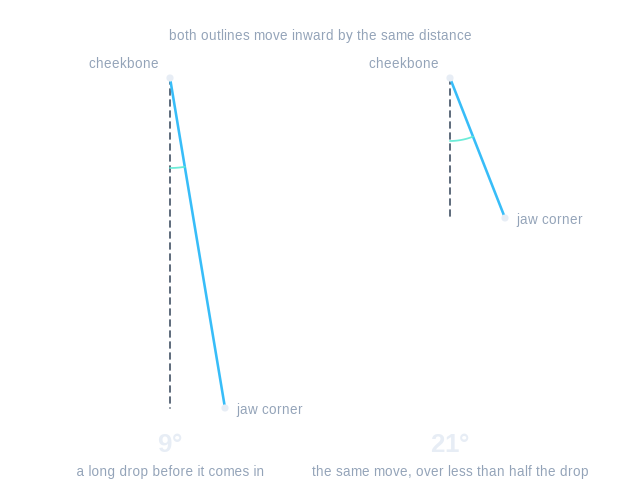
Reading the three numbers together
The jaw pages on this site each answer one question, and it is worth keeping them apart. Jaw width against face width says how much of the face's width the jaw takes up. The turning angle says how abruptly the outline changes direction at the corner. The taper says how steeply the outline travels to get there. A square jaw, a tapered jaw and a round jaw are different combinations of those three, and none of them is measured by the word "sharp".
The practical use is comparison with yourself: the two sides of one face, or the same face in two photos taken the same way. The number is stable enough for that, and not stable enough for anything else. Comparing it with a stranger's photo compares two cameras and two lights as much as two jaws.
What this page will not tell you
It will not tell you whether your jawline is good, sharp, defined or worth changing. Those are not measurements, and the words carry a lot of marketing. It will not give you a band to fall into: the shallow / moderate / steep labels above the table are this page's own cuts, placed where front-facing photos tend to land, not values from a study.
And it will not tell you that anything you do to your face will change the bone. Soft tissue, posture and the camera change what a photograph shows, quickly and reversibly. Anything beyond that is a conversation with a clinician, not a number on a page.
Sharp jawline questions
What does a sharp jawline mean?
It describes a photograph more than a face: an edge where the jaw meets the neck or the background, with enough contrast and enough resolution to read as a line rather than a gradient. The same jaw produces that edge under a hard side light and loses it under flat frontal light.
Can you measure how sharp a jawline is?
Not as a single number. Sharpness is a property of an edge, and an edge depends on the light, the soft tissue, the focus and the file. What a landmark mesh gives is the geometry of the outline, which is what this page prints.
What is the taper angle?
The angle between vertical and the line joining the widest point of the cheekbone to the jaw corner, measured on each side and averaged. Zero degrees means the outline falls straight down; larger angles mean it moves inward over a shorter vertical distance.
What is a normal taper angle?
There is no published band, because this is not a measurement anyone publishes. The three labels on this page — shallow below 11°, moderate to 16°, steep above — are this page's own cuts, drawn around where a front-facing photo tends to land, not values from the literature. The number is worth comparing with your own other side and your own other photo, and with nothing else.
Does the angle change with the camera?
Yes, a lot. Tilting the chin down foreshortens the lower face: the drop shrinks while the inward movement stays the same, so the angle grows without the face changing. Raising the camera does the same thing. A phone held slightly above eye level is enough to move the number by several degrees.
Can the taper angle be changed?
The bone sets the outer limit, and soft tissue decides how much of it a photograph shows. Body fat, hydration, jaw posture and the angle of the head all move what the outline does in a picture; none of them moves the bone. Anything claiming to change the bone itself is a clinical question, and not one a number on a page can answer.