Gonial angle — what a front photo measures instead, and why the number runs wide
The angle sits between two edges of bone, and one of them points away from the camera. So a front photograph cannot contain it — what it contains is the place where the jaw outline turns, which is a projection of the corner and a wider number — wider by an amount that belongs to the face.
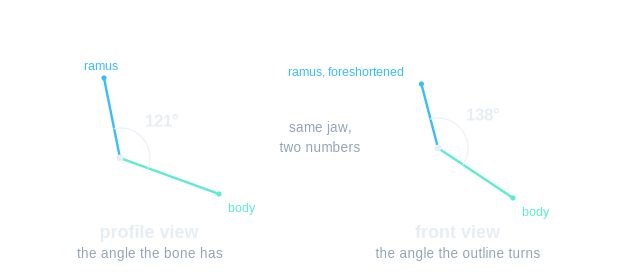
The ramus — the upright part of the jaw that runs toward the ear — points backwards, so in a front view it is hidden behind the cheek. What you see and what a mesh can trace is the mandible's outer border, and the angle it turns through at the corner is a projection of the real corner, not the corner itself. It reads wider: in the worked example below, 138° where the bone has 121°, on the same head. That gap is not a constant, so it cannot be subtracted off. The number below is the projected angle, labelled as such everywhere it appears.
1 · Your photo
Choose a photo. The engine loads when you press Analyze.
2 · What the test saw
3 · The turning angle of the outline
Nothing measured yet.
4 · The rest of the face
Jaw width against cheekbone width is one of the eight scored measurements on the main test, and it is the one most people are actually asking about when they ask about the jaw. It comes from the same two landmark pairs this page uses.
Open the full attractiveness testWhat the angle actually is
The mandible is a horseshoe with two uprights. The uprights — the rami — run up in front of the ears toward the temporomandibular joint; the horseshoe itself is the body, and it carries the teeth and ends at the chin. Where a ramus meets the body there is a corner, and the angle on the inside of that corner is the gonial angle.
It is a real angle between two real edges, and it can be measured to a degree on a lateral skull radiograph. Published means for adults sit around 120–130°, with a tendency to open slightly with age as teeth wear and the bone remodels. The spread between individuals is wide enough that the number on its own says very little — but it is at least a measurement of something that exists.
The word comes from gonion, the point on the jaw where the angle is, and it appears in orthodontics, in forensic anthropology and in a great deal of internet writing about jawlines. In the last of those it is usually reported without a view, which is the problem this page is about.
What a front photo has instead
Turn a head to face the camera and the ramus disappears. It runs backwards from the corner toward the ear, so in a front view it is foreshortened to almost nothing and covered by the cheek. What remains visible is the mandible's outer border: a line that comes down from in front of the ear, turns at the corner, and runs forward to the chin.
That line has a corner too, and its angle can be measured. It is just not the same corner. The bone's angle is between two edges that both have depth; the outline's angle is between one edge lying in the picture plane and one that has collapsed into it. Foreshortening removes the component that sharpens the angle, so the projected version opens up. In the drawing below, the same head reads 121° from the side and 138° from the front: a 17° gap, produced by one change of viewpoint.
Why you cannot subtract a fixed number
The obvious move is to treat the difference as a constant and correct for it. That does not work, and the reason is worth stating because it applies to every measurement on this site that involves depth: the amount of foreshortening depends on how far the jaw corner sits behind the cheek, which varies with the width of the face, the thickness of the soft tissue over the corner, and the angle the head is held at.
Two faces can produce the same front-view outline from jaws that differ by 15° in reality. A heavy masseter pushes the visible corner outward and back, widening the projected angle without touching the bone; losing weight does the reverse. So the front number is a real measurement of the outline and a poor estimate of the bone, and the two cannot be separated from one photograph.
How to measure the real one
It takes a profile view, and the setup matters more than the tool:
- Turn the head ninety degrees to the camera, with the eye line level and the ear and the chin both in frame. A phone held at eye height, a metre away, on a plain background, is enough.
- Mark three points: the back of the jaw corner, the top of the ramus just in front of the ear, and the most forward point of the chin.
- Measure the angle at the corner between the line to the ear and the line to the chin. That is the gonial angle as a photograph can give it.
Two caveats, both of which matter more than the measurement precision. The skin line is not the bone line: the soft tissue over the corner is several millimetres thick and varies between people, so a photograph always reads slightly wider than a radiograph of the same jaw. And a true lateral view is hard to hold — a few degrees of head rotation changes the projection, which is exactly the problem described above, arriving again from the other side.
What moves the front number
- Head rotation. The largest factor. Turning the face even ten degrees toward one side brings one ramus into view and hides the other, so the two sides stop being comparable and the average drifts.
- Camera height. Looking down at the face compresses the jaw and widens the turning angle; looking up from below does the opposite. A phone held at chest height is a different measurement from one held at eye height.
- Masseter and soft tissue. The mesh's jaw corner sits on the skin, so a bulky masseter or a soft jaw moves the point outward and the angle wider, with the bone unchanged.
- Expression. A clenched jaw tightens the outline and can move the corner; a relaxed face and a posed one differ by a few degrees.
- Weight and age. The two factors here that are real changes rather than changes in the photograph, and both are slow.
Which is the practical point of the whole page: the number is worth comparing against itself on a fixed setup, and against nothing else. Comparing it with a gonial angle from a study, or with a number another tool reported from another photo, compares a projection with a bone.
Gonial angle questions
What is the gonial angle?
The angle at the corner of the lower jaw, between the ramus — the upright part running toward the ear — and the body of the mandible, which runs forward to the chin. It is measured on a lateral radiograph or a true profile photograph, and it describes how steeply the jaw turns from vertical to horizontal.
What is a normal gonial angle?
Published means sit around 120–130° in adults, with a tendency to open slightly with age as teeth wear and the jaw remodels. The range across individuals is wide enough that a single number says little on its own, and values differ between populations and between measuring methods.
Can you measure the gonial angle from a front photo?
No. The ramus points backwards, so in a front view it is hidden behind the cheek and the visible outline is the mandible's outer border. A front photo can measure where that outline turns, but that turning angle is a projection of the real corner rather than the corner itself.
Why is the front-photo number larger?
Because the ramus is foreshortened to almost nothing in a front view. The real angle is between two edges that both have depth; the projected angle is between one edge in the picture plane and one that has collapsed into it. Foreshortening removes the component that would sharpen the angle, so the angle opens up. In the worked example on this page the same head reads 138° from the front against 121° from the side — a 17° gap from one change of viewpoint. On a real face the gap varies with how far the corner sits behind the cheek and how thick the soft tissue over it is, so no constant correction works.
How do you measure it properly?
With a true lateral view: a profile photograph with the head in a fixed position, or better a lateral cephalometric radiograph. Mark the back of the jaw corner, the top of the ramus near the ear, and the most forward point of the chin; the angle at the corner between the first two and the first and third is the gonial angle. On a photograph the skin line is not the bone line, so even this is an estimate.
Does the gonial angle affect how the jaw looks?
It is one of the things that does, along with jaw width, chin projection and the soft tissue over the bone. A sharper angle tends to read as a more defined jaw in profile; a wider one as a softer jaw. But the same bone looks different under different soft tissue and different light, which is why a photograph is a poor instrument for the question.
Can the gonial angle be changed?
Only by surgery that cuts or repositions the mandible, or by procedures that add material to the corner. Masseter size changes the outline over the bone without changing the bone, and weight change moves the soft tissue. Nothing here measures the result of any of that, and none of it is a reason to have it done.
Is a lower gonial angle better?
There is no measurement that says so. A sharper angle is associated in some studies with a jaw that reads as more defined in profile, and a very wide angle with a less defined one, but the range in ordinary faces is broad and the effect is small next to soft tissue, posture and light. Treating a single angle as a score is a habit of the tools that report it, not a finding.
Related pages
- Jawline — jaw width against cheekbone width, which is the jaw measurement a front photo can actually support.
- Face shapes — length, width and the cheekbone-to-jaw ratio as two axes.
- Golden ratio face — eight ratios, and the arithmetic that makes a hit meaningless.
- Hunter eyes — the same depth problem in the eye area: two claims a front photo cannot check.
- Attractiveness test — eight ratios, none of which needs a side view.
- About this site — the claims these measurements make, and the ones they refuse to make.