Canthal tilt — the angle from inner to outer eye corner
One photo, four landmarks, two angles in degrees. The corners are printed on the photo and the arithmetic is on the page, so the number can be redrawn by hand rather than trusted.
The landmark model ships with the page and runs on WebAssembly in your browser. No account, no upload. The page's security policy names the few origins it may reach — its own folder, the page counter, and Google's ad hosts — and the browser refuses every other one. An upload has no route off this device that this site put there.
1 · Your photo
Choose a photo. The engine loads when you press Analyze.
2 · What the test saw
3 · The angle
Nothing measured yet.
4 · The rest of the face
Canthal tilt is one of eight ratios in the full test. The other seven — symmetry, thirds, fifths, length to width, midface, jaw width, mouth to nose — are on the main page, with the same treatment: every band printed, every weight adjustable.
Open the full attractiveness testCanthal tilt: what the angle is
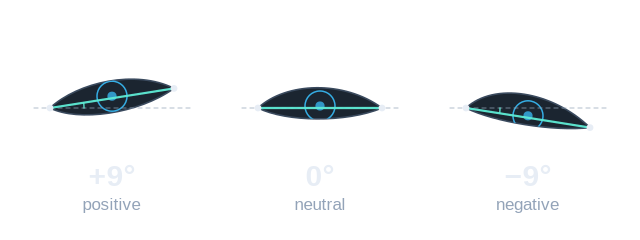
The canthus is the corner where the upper and lower lid meet, and there are two per eye: the medial canthus at the nose, the lateral canthus at the temple. Canthal tilt is the angle of the line joining them, measured against horizontal. If the lateral corner sits higher than the medial one the line rises towards the temple and the angle is positive; if it sits lower the line falls and the angle is negative.
That is the whole definition. It is a geometric property of the eye opening, it is measured in degrees, and it says nothing on its own about a person.
How this page measures it
Four landmarks out of the 478: 133 and 33 for the left eye's inner and outer corner, 362 and 263 for the right. For each eye the page takes the vertical difference between the two corners, divides it by the horizontal distance between them, and converts that to degrees with an arctangent. The number printed large is the average of the two eyes; the per-eye values are printed under it.
Two consequences of doing it this way are worth stating plainly. First, the angle lives in the plane of the photograph: it is measured against the image's horizontal, not against the ground, so a head rolled three degrees to one side reads three degrees different. Second, the corners are found from pixels by a landmark model, so anything that changes the appearance of the corner — liner, lashes, glare, the lid itself — moves the point that gets measured.
The four indices are the same ones the main tool uses. If you want to check the arithmetic, the full test prints the landmark numbers next to every measurement.
Why the same face gives different numbers
This is the most useful thing to know about the measurement, because it explains most of the surprise people get when they run it twice:
- Head roll. The largest single factor. Three degrees of head tilt moves both eyes by about three degrees, and nobody holds their head perfectly level for a photo.
- Camera height. Shooting from above the eye line compresses the eye opening and can read as a lower lateral corner; shooting from below does the opposite.
- Distance and lens. A phone held close uses a wide lens, and the perspective pushes the outer corners back and down relative to the centre of the face.
- Expression. Squinting, smiling with the eyes, or raising the brows all change where the lid meets at the corners.
- Makeup and lashes. A wing that extends past the corner pulls the detected point outwards; heavy liner on the waterline can do the same in the other direction.
- Glasses. Frames sitting across the corner, or a reflection over the eye, can hide the point entirely.
The practical version: to compare two readings, keep the camera at eye level, the head straight, the expression neutral, and the lighting the same. Comparing a selfie taken from above with a webcam shot from below measures the two cameras, not the two eyes.
What positive and negative do not mean
Nothing in this measurement supports a claim about personality, character, health, or how attractive a person is. The frequently repeated line that a negative tilt reads as tired or older is a statement about how faces are read in photographs, and it is a claim about perception that this page does not test and does not repeat as fact. What the page can tell you is where two points sat in one photograph, and how far that line was from horizontal.
It also is not a diagnosis. If you are looking at a change in the shape of your eye opening — drooping, asymmetry that appeared recently, a lid that does not close — that is a conversation with a doctor, not a measurement from a web page.
The ±6° reference band
The full test scores each measurement by how close it sits to a stated band, and for canthal tilt that band is ±6° around level. That number is this page's own choice, made so that ordinary photographic variation does not swamp the reading. It is not a clinical threshold and it is not a population average: published work that uses the term defines the corners differently from study to study, so a cut-off borrowed from one of those definitions would not mean the same thing here.
The band does not change the measurement. It only decides how much of the composite score this row contributes, and on the main page you can widen or tighten every band at once and watch the composite move while the degrees stay exactly where they were measured.
Where the number is actually worth something
Comparing one face to another is where this measurement is weakest: the difference between two people's angles is usually smaller than the difference between two photographs of the same person. Comparing the same face to itself, with the same camera position and the same light, is where it holds up — a fixed setup, one photo a month, and the numbers become a record of the setup as much as of the face.
Canthal tilt questions
What is a positive canthal tilt?
The outer corner of the eye sits higher than the inner corner, so the line joining them rises towards the temple and the angle comes out positive. On this page that is the entire meaning of the word — no implication about health, age or appearance is attached to it.
What counts as a neutral canthal tilt?
Here, an average under one degree in either direction is reported as level. That cut-off is this page's own, chosen because below a degree the measurement is inside its own photographic noise. It is not a published standard.
Is the angle measured per eye or averaged?
Both are printed. The large number is the average of the two eyes; the left and right values sit under it with their difference. The main tool averages them for its composite, but asymmetry between the two eyes is common enough that showing only the average would hide the more interesting number.
Why is my canthal tilt different in two photos of the same face?
Head roll, almost always. Tilting the head three degrees adds about three degrees to both eyes, because the angle is measured against the horizontal of the photograph rather than against the ground. Camera height, lens, squinting and eyeliner all move it as well — the list above is ordered by how much each one usually contributes.
Does eyeliner or mascara change the measurement?
It can. The corners are found by a model looking at pixels, so a wing extending past the outer corner can pull the detected point outwards and change the angle by a degree or two. False lashes and heavy shadow can do the same.
Does it work if I wear glasses?
Usually, if the frames do not cross the corners and there is no strong reflection over the eyes. Thick frames resting on the lid line, or glare across the eye, can hide or move the corner points and produce an angle that belongs to the glasses rather than to the eye.
Is canthal tilt the same thing as hooded eyes?
No. Hooding describes how much of the lid is covered by the fold above it; canthal tilt is the angle of the corner-to-corner line. They are often discussed in the same breath and they are separate measurements — this engine measures only the corners. The hooded eyes page takes the lid side of the question, including why a landmark model cannot see the crease.
Related pages
- Attractiveness test — all eight ratios, the 0–100 composite, and the weights you can move yourself.
- Hooded eyes — the fold, the four look-alikes, and the two numbers a photo can measure.
- Hunter eyes — the six forum criteria, the four a front photo can check, and the two it cannot.
- Face shapes — the six standard outlines as two ratios, and where the ranges overlap.
- Jawline — jaw width against face width, plus the corner angle.
- Norwood scale — the eight stages of male pattern hair loss, and why a photo cannot stage you.
- About this site — what the measurement claims and, more importantly, what it does not.