Norwood scale — the eight stages of male pattern hair loss
A descriptive scale, not a measurement: where the hairline sits and how much of the crown has thinned, sorted into eight patterns. Drawn here from the definition, with the parts it leaves out stated as plainly as the parts it covers.
The Norwood scale — the Hamilton–Norwood scale, after the two people who published it — sorts the visible pattern of male pattern hair loss into eight stages. It is a classification, not an instrument: nothing is counted or measured, and the stage is decided by looking at where the hairline has moved to and how much of the crown has thinned. It has been in use since the 1970s and it is still the shared vocabulary, which is exactly why it is worth knowing what it does and does not say.
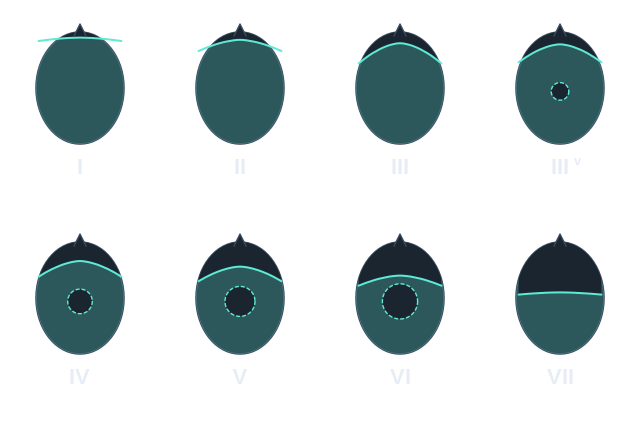
The eight stages, one line each
| Stage | What it describes | What it does not say |
|---|---|---|
| I | No visible recession; the hairline runs roughly straight across the temples. | Whether any hair is being lost. Loss can start before it is visible. |
| II | Slight recession at both temples, usually symmetrical, forming a shallow V. | Whether the recession will continue. Some hairline changes stop here. |
| III | Deep recession at the temples; the bare areas reach back to the mid-scalp, with hair still across the front centre. | How thin the rest of the top is. |
| III vertex | Recession at the temples plus a visibly thinning patch at the crown. | Whether the two areas will meet — often they do not. |
| IV | Frontal recession and crown thinning have both grown, with a band of hair still separating them. | How dense that separating band is. |
| V | The separating band is narrower and thinner; the two bare areas are close to meeting. | Anything about the sides or the back. |
| VI | The band is gone or nearly gone; frontal and crown areas read as one. | Whether the rim of hair is stable. |
| VII | Only a horseshoe of hair remains around the sides and back. | Whether anything can still change, in either direction. |
What the scale is actually describing
Two things, and only two: the position of the frontal hairline, and the extent of thinning at the crown. Every stage is a combination of those. That is why the scale is quick to apply and why it travels so well between clinics — two people looking at the same head tend to land on the same stage, because there is very little to disagree about.
It is also why the scale is coarser than it looks. Stages IV, V and VI are separated by how much hair is left in the band between the front and the crown, which is a judgement rather than a count. Two heads can be assigned different stages on the strength of a few centimetres of hair.
What the scale leaves out
- Density. A stage says where hair is missing, not how much is left per square centimetre. Two people at stage III can differ by a factor of two in how much hair they actually have.
- Diffuse thinning. Hair that thins evenly across the whole top, without a receding hairline or a bald crown, does not fit the scale well at all — the pattern is the point of the scale, and this pattern has none.
- Rate. A stage is a snapshot. It says nothing about whether the change took two years or twenty, or whether it has stopped.
- Women. The scale was built around the pattern men typically show: frontal recession and crown loss with a preserved rim. Female pattern loss is usually diffuse and keeps the frontal hairline, and is described with other scales (Ludwig, Savin).
- Age and background. Hairline position varies widely between individuals and between populations at any age, so a stage read off a single photograph is a weak signal about anything except the photograph.
Why a photo cannot stage you
The stage is a judgement about where the hairline sits on the scalp, and a photograph is a projection of that scalp through a lens at an angle. Everything that changes the projection changes the reading:
- Camera height and angle. Shot from above, a forehead reads larger and a hairline reads further back. Shot from below, the opposite.
- Lighting. A light directly above puts the crown in shadow and hides thinning; a light from the front flattens it and shows nothing; a light from the side exaggerates it.
- Hair length and styling. Long hair combed forward covers recession completely. Wet hair separates and shows scalp that is not otherwise visible.
- Framing. A crop that cuts the crown out of the picture removes the half of the scale that stages IV to VII are about.
None of this means the scale is useless. It means the scale is applied to a head, in person, by someone who can part the hair and look at the scalp — and that a web page, including this one, cannot do that.
A mature hairline is not the same as pattern loss
Many men develop a slightly higher, slightly more angular hairline in their twenties and thirties and then stay there for decades. That is usually called a mature hairline, and it is not a stage on this scale so much as a reason the lower stages are hard to read from one photograph: a stage II can be the beginning of pattern loss or the end of a normal change, and the picture looks the same either way.
What separates them is time, which is the one thing a single photo cannot supply. The practical version: the same photo, same distance, same light, same angle, every three or four months, and compare the series rather than any one frame. That is a better record than any stage number read off a selfie.
Where this connects to the measurements on this site
This site measures face geometry, not hair. There is one place where the two touch, and it is worth being precise about it: the facial thirds measurement runs from the top of the face mesh down to the brow, then brow to nose, then nose to chin. A hairline that has moved back does not move the mesh — the model places its top point on the forehead, not on the hair — but a very high forehead does change how that upper third reads against the other two.
The other seven measurements — symmetry, fifths, length to width, canthal tilt, midface, jaw width, mouth to nose — use points on the eyes, nose, mouth, jaw and chin, and are not affected by the hairline at all. If you want the face side of this, it is on the attractiveness test page; the eye angle on its own is on the canthal tilt page.
This page is a description of a classification that other people published. It is not medical advice, it is not a diagnosis, and it cannot tell you whether you are losing hair. If that is the question, it belongs to a doctor who can look at your scalp.
Norwood scale questions
What are the eight Norwood stages?
I, II, III, III vertex, IV, V, VI and VII. I to III describe recession at the temples; III vertex adds crown thinning; IV to VII describe how far the frontal and crown areas have grown and whether a band of hair still separates them. VII leaves hair only around the sides and back.
Can I stage my own hair loss from a photo?
Not reliably. The stage depends on where the hairline sits on the scalp and on how thin the crown is, and both of those shift with camera angle, lighting, hair length and whether the hair is wet. The same head photographs as different stages on different days.
Is a receding hairline always hair loss?
No. A mature hairline — a slight, stable recession at the temples — is common and does not necessarily keep moving. What separates it from pattern loss is change over time, which is why a series of identical photos says more than any single one.
Does the Norwood scale apply to women?
No. It was built around the pattern men typically show. Female pattern hair loss is usually diffuse, keeps the frontal hairline, and is described with other scales such as Ludwig or Savin.
What does the scale leave out?
Density, rate of change, and diffuse thinning. A stage says where hair is missing, not how much is left, and not how fast anything is happening.
Does hair loss change the measurements on this site?
It changes one of them, indirectly. Facial thirds is measured from the top of the face mesh to the brow, so a very high forehead changes how that upper third reads. The other seven measurements use points on the eyes, nose, mouth, jaw and chin and are unaffected by the hairline.
Related pages
- Attractiveness test — the eight geometric ratios, with every reference band printed.
- Canthal tilt — the eye angle in degrees, measured from four landmarks.
- Face shapes — the six standard outlines as two ratios, and where the ranges overlap.
- Jawline — jaw width against face width, plus the corner angle.
- About this site — what the measurement claims, and what it does not.