Face shapes — six outlines, two ratios, and where they overlap
The six standard outlines written as two ratios you can measure, with the ranges printed out — and with the overlaps left visible, because the overlaps are why two face shape tests give two answers.
A classifier would have to pick a winner among overlapping ranges and present the pick as a fact about you. What it can do honestly is hand you the two ratios and the table, which is what follows. The attractiveness test measures both ratios and prints the pixel spans behind them.
What a face shape actually is
A face shape is not a property of a face the way height is. It is a label produced by comparing the outline of a face against three widths — forehead, cheekbones, jaw — and a length. Change which of those you measure, or where you put the cut-offs, and the label changes while the face does not.
The vocabulary comes from styling: haircutting and makeup writing needed a handful of buckets to give advice in, and the six below are those buckets. That origin is worth knowing, because it explains both what the labels are good for (choosing a haircut, roughly) and what they are not (a description of a person, or a finding of any kind). It also explains why the vocabulary is written for women's styling and only borrowed by men's hair and beard advice — the ranges were never redefined for that second use, they were carried over.
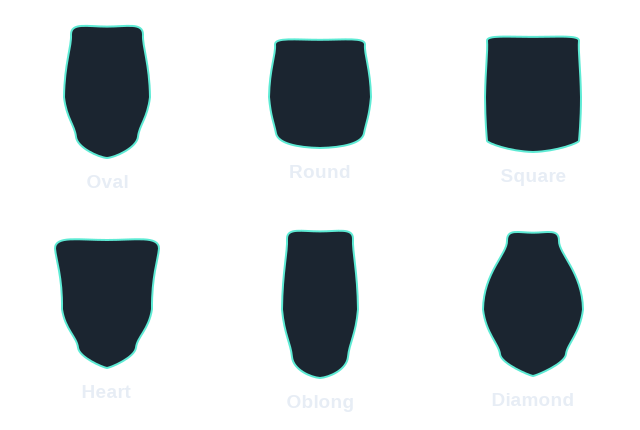
Two ratios, and the ranges that go with them
Almost every version of the classification can be rebuilt from two numbers: face length divided by face width, and jaw width divided by cheekbone width. The table gives a range for each shape on both. Face width is measured at the widest point of the cheekbones and face length from the hairline to the chin, which is the classical definition and also the first place this gets slippery — see the forehead section below.
| Shape | Length ÷ width | Jaw ÷ cheekbones | Forehead |
|---|---|---|---|
| Oval | 1.30 – 1.50 | 0.68 – 0.78 | a little narrower |
| Round | 1.00 – 1.15 | 0.80 – 0.92 | same as the cheekbones |
| Square | 1.05 – 1.25 | 0.88 – 1.00 | same, with a flat hairline |
| Heart | 1.20 – 1.45 | 0.60 – 0.72 | the widest part of the face |
| Oblong | 1.55 – 1.90 | 0.68 – 0.80 | a little narrower |
| Diamond | 1.30 – 1.60 | 0.62 – 0.74 | clearly narrower |
These ranges are this page's own, assembled by translating the usual verbal descriptions into numbers. They are not from a study, and a study would have nothing to check them against, because the categories predate any attempt to test them. Treat the table as a reading aid for a convention, not as a standard. Other sites will print different numbers, and theirs are equally their own.
Where the ranges overlap, and what that means
Read the table column by column and the overlaps are the interesting part:
- Oval, heart and diamond share most of their length range. Between 1.30 and 1.45 all three are in play, and the thing separating them is how wide the forehead is relative to the cheekbones. That width, which no landmark gives you, is doing most of the work in three of the six categories.
- Round and square overlap on length almost entirely. Between 1.05 and 1.15 both fit, and the tiebreak is the jaw: square keeps a jaw close to cheekbone width, round does not. Their jaw ranges overlap between 0.88 and 0.92, so inside that band the two labels are 0.04 apart.
- Oval and oblong leave a gap. This table stops oval at 1.50 and starts oblong at 1.55, so a face at 1.52 falls between two rows — and a site that runs oval to 1.55 would call that face oval, while one that starts oblong at 1.48 would call it oblong. Nothing about the face changes at 1.52.
This is why two face shape tests disagree about the same person, and it is not a bug in either. Both are doing a nearest-neighbour match against ranges they chose. When a face sits inside two ranges, the site's tiebreak decides, and the tiebreak is usually undocumented.
The third width, which a photograph cannot settle
Forehead width is what separates heart from oval and diamond from oval, and it is the width with no landmark. The 478-point face mesh has no points on the hairline; its topmost point is the top of the mesh, which sits above the forehead and moves with the hair. So the "face length" in the ratio above is really mesh-top to chin, and the forehead width has to be estimated by eye from where the hair starts.
Two consequences follow. First, a fringe, a receding hairline, a buzz cut or a hat changes the estimate without touching the face — which is why the same person can read as heart in one photo and oval in another. Second, any automated face shape detector has the same problem, and most of them solve it by quietly using cheekbone width for the forehead term or by ignoring the forehead and letting the other two ratios decide. That is a reasonable engineering choice and a poor thing to present as a classification.
What moves the reading, in rough order
- Lens and distance. A phone at arm's length widens the centre of the face and pushes the outline back, so the face reads narrower and longer than it is. Step back and zoom and the same face reads wider and shorter — enough to cross from oblong into oval.
- Head pitch. Chin down shortens the visible face and flattens the jaw; chin up lengthens it and sharpens the jaw. A few degrees is enough to shift the length ratio by more than the gap between two categories.
- Weight. Soft tissue at the cheek and under the jaw moves both the cheekbone width and the jaw width. This is the one factor here that is a real change in the face rather than a change in the photo.
- Facial hair. A beard that extends past the jaw line is followed as if it were jaw, which pushes the jaw ratio up towards square.
- Hair. The only stand-in for the forehead. A blunt fringe adds apparent width; a centre part with volume at the sides narrows it.
- Expression. A wide smile pulls the cheek and can add a few percent to the cheekbone width, which lowers the jaw ratio without anything having moved.
What the labels do not say
Being in one row of the table is not better or worse than being in another. The idea that oval is the ideal shape is a styling convention — oval is simply the easiest shape to cut around — and it has been repeated so often that it now reads as a finding. It is not one. Nothing here predicts how attractive a face is, how symmetrical it is, or anything about health, character or temperament, and this page does not measure any of those.
Two further things the table is not. It is not anatomical: there is no structure in the skull called an oval face, and the categories do not correspond to anything a maxillofacial surgeon would measure. And it is not stable across a lifetime, because the soft tissue sitting on the bone changes with weight and age while the bone does not.
Face shape questions
How do I work out my face shape?
Measure the two ratios on a straight-on photo, then find the row both numbers fall into. Expect to land in two rows, and expect the answer to depend on where the ranges are set. The eight-ratio test prints both; the jawline page prints the second one with the pixel spans behind it. Take both from the same photo or the comparison is meaningless.
Why do two face shape tests give different answers?
The ranges differ, the forehead is unmeasurable, and the photo moves the numbers. In that order. A face at 1.52 is oval on one site and oblong on another because of the first; a face with a fringe is heart on one and oval on another because of the second; a selfie taken from above reads longer than a webcam shot because of the third.
Is an oval face the ideal face shape?
No — that line comes from styling writing, not research. Oval is described as ideal because it is easy to cut hair around, which is a claim about convenience for a stylist. On this page it is one row of a table with ranges attached.
Can an app detect my face shape reliably?
An app can measure the two ratios about as well as anyone can from a photo. What it cannot do is make the category objective, because it still has to compare those ratios against ranges somebody chose, and the forehead problem stays unsolved. A detector is a nearest-neighbour match wearing a confident voice.
Does my face shape change?
The bone does not change after growth; nearly everything measured on top of it does. Weight, age, a beard and a haircut all move the reading, and two photos of the same person ten years apart can land in two different rows without any bone having moved.
How many face shapes are there?
There is no agreed number. Six is common — oval, round, square, heart, oblong, diamond. Many sources list seven and add triangle or pear; some add rectangular and drop oblong; heart is sometimes called inverted triangle. A classification whose membership list changes between sources is a vocabulary, not a measurement.
Related pages
- Attractiveness test — eight ratios including face length ÷ width, the composite, and the weights.
- Jawline — jaw width against cheekbone width, with the pixel spans printed.
- Canthal tilt — the eye angle, per eye, in degrees.
- Norwood scale — the eight stages of male pattern hair loss, and why a photo cannot stage you.
- About this site — what the measurements claim, and what they do not.