Hunter eyes — six claims, and the four a photo can check
The word comes from a forum ranking, not from anatomy, so there is no threshold to test against. What can be done is to take the six claims it stands on and ask, one at a time, which of them a front photo can actually read — and which are the third dimension wearing a costume.
Four of the six usual criteria are geometry, and this page measures all four per eye. The other two — how deep the eye sits and how far the brow projects — need a side view, and a front photo cannot supply one: it flattens depth into shadow, and shadow moves when the light moves. Where a number exists it is printed. Where it does not, the row is left empty rather than filled with an estimate.
1 · Your photo
Choose a photo. The engine loads when you press Analyze.
2 · What the test saw
3 · Four readings, two eyes
Nothing measured yet.
4 · The rest of the face
Canthal tilt is one of the eight ratios in the full test, where it is scored as a deviation from level in either direction rather than as a number to push up. The other seven, and the weights you can move yourself, are on the main page.
Open the full attractiveness testWhere the word comes from
"Hunter eyes" did not come from an anatomy text. It grew out of looksmaxxing and PSL forums in the late 2010s, alongside a matching opposite, "prey eyes", and the pair did a specific job in those places: sorting faces into a hierarchy. One end of the scale was named after a predator, the other after its food. That origin is worth knowing before anything else on this page, because it explains why the term is so easy to recognise and so hard to define — it was built to rank, and ranking does not need a boundary.
The features it points at are real, though. Strip the names away and the description is a list: eyes set back under a brow that projects, an upper lid that sits low on the iris, an outer corner above the inner one, a lower lid that shows no sclera, an opening longer than it is tall. Six traits, each of which can be said in plain geometry. What follows treats them that way — as six claims to check rather than one label to apply.
A note on the vocabulary itself. "Prey eyes" is not a neutral description; it is an insult with a diagram attached, and the communities that coined it use both terms to rank people. This page uses the words only because they are what people search for, and it takes no position on the ranking — there is no evidence behind it, and none of the measurements below reward one end of the scale.
The six claims
Each row is one of the usual criteria, and the third column is what this page can actually put next to it. Four rows get a number from the 478-point mesh. Two do not, and the reason is the same for both.
| Claim | Readable from a front photo? | What this page prints |
|---|---|---|
| Upper lid sits low on the iris | yes — the lid edge is a mesh point | share of the iris height covered, per eye |
| Outer corner higher than inner | yes — both corners are mesh points | the angle, in degrees, per eye |
| No sclera below the iris | yes — lower lid edge and iris bottom | lower lid exposure, per eye |
| Opening longer than tall | yes — lid edges and corners | opening height ÷ corner distance |
| Eye sits deep in the socket | no — depth is the third dimension | — (needs a profile view) |
| Brow ridge projects | no — same reason | — (needs a profile view) |
Two out of six is not a small omission, because those two are the ones the phrase is really about. "Deep-set" is the first word most people reach for when describing this look, and it is precisely the word a front photo cannot support. The next two sections take the readable four and then the unreadable two.
What the four readings are
- Upper lid over iris. How far the visible upper lid edge has come down over the iris, as a share of the iris diameter. On a 12 mm iris, an edge that has come down 2 mm reads 17%. A negative value means the edge never reached the iris at all and white shows above it.
- Lower lid below iris. The same idea upside down: the gap between the lower lid edge and the bottom of the iris, over the diameter. In a neutral, wide-open eye the lower lid rests on or just above the iris edge, so this sits near zero. A smile lifts the lower lid by a couple of millimetres — on a 12 mm iris that is a fifth of the diameter — so a laughing photo reads strongly negative. A positive number is scleral show.
- Outer corner vs inner. The angle of the line joining the two corners of one eye. Positive means the outer corner is higher. This is the same number as the canthal tilt on its own page, repeated here because it is one of the six claims.
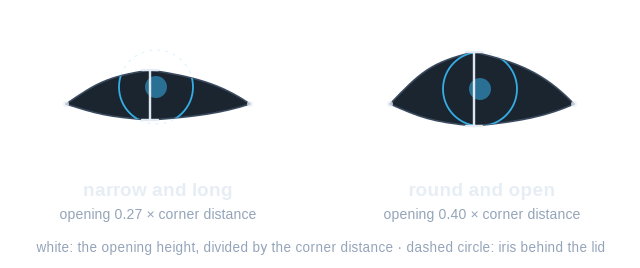
- Opening ÷ corner distance. The height of the opening at its centre divided by the distance between the corners. Both are in the same units, so the ratio says how narrow and long the eye reads regardless of how large it is in the photo. A round eye comes out near 0.4; a narrow one near 0.25.
One detail decides whether the first two rows mean anything, and most eye-area tools get it wrong. A circle's width is its diameter; its height here is not, because the lids are the thing cutting it. Take the vertical extent as the diameter and the lid edge becomes the iris edge, which shrinks the denominator by however much is hidden and inflates both percentages at once. This page takes the width, then asks where each lid sits against that circle.
The iris ring is fitted, not traced. Its five points sit on a circle the model assumes rather than on the boundary it can see, so on a narrow or half-closed eye the fitted circle can overshoot the real iris by several per cent. That inflates the denominator and pulls every percentage here toward zero — both rows at once, in the same direction. Knowing which way the error runs is about as much as can be claimed for it.
Why depth and brow cannot be read from the front
Both of the missing claims are statements about how far something sits from the camera, and a single front-facing photograph has no way to record that. A camera projects three dimensions onto two, and the information it discards is not recoverable afterwards: a small eye close to the lens and a large eye far from it produce the same pixels. What survives the projection is shading, and shading is a picture of the light rather than of the bone.
This is easy to demonstrate on your own face. Take one photo with a lamp above the camera and one with the light coming from straight ahead. The socket will look deep in the first and shallow in the second, with nothing about your skull changing between the two frames. Every "eye area score" that includes socket depth is measuring that difference. The number it produces is a darkness reading in a region, and it moves when a cloud passes the window.
The brow has the same problem from a different angle. How far a brow projects is a comparison between the brow and the front surface of the eye, and in a front view both sit at the same place in the image. You can see the shadow under a brow, and you can see that a brow is heavy or light, but the projection itself — the millimetres between the brow ridge and the cornea — is not in the picture.
What moves these four numbers
All four are soft-tissue positions read from one frame, which makes them sensitive to the frame rather than to the face:
- How wide the eye is open. Squinting raises the lower lid and drops the upper one, which shrinks exposure and raises coverage in the same instant. A relaxed eye and a posed one can differ by more than the difference between two people.
- Gaze direction. Look down and the eyeball turns away from the upper lid and toward the lower one: coverage climbs, exposure drops. Hold the phone at chest height and you have done this to yourself without noticing.
- Camera height. A lens above the eye line shortens the opening and flattens both arches; a lens below it does the reverse. The height-to-width ratio moves with the camera, which is the reading most people assume anatomy fixed.
- Expression. A smile lifts the lower lid by a couple of millimetres, which is enough to move lower exposure from positive to negative on its own.
- Makeup and lashes. Liner on the lower waterline reads as a lid edge, and a lash line above the upper lid reads as one too. Both are exactly where the model looks for the boundary.
- Lenses. A coloured or enlarging contact lens is a different iris circle, and the ring is fitted to what the model sees.
- Age and fatigue. The only factors here that are real changes in the eye rather than changes in the photo: lid tone falls and lower exposure rises, slowly and unevenly between the two sides.
Which leaves one honest way to use them: against yourself, on a fixed setup — same distance, same lens height, same lamp, same face. Line up two photos of two different people and what has been measured is two photographs, not two people.
Three checks that need no photo
- Turn your head ninety degrees and take a profile photo. This settles the two claims that a front photo cannot: the depth of the eye behind the brow and the projection of the brow over it are both obvious in a side view. It takes one extra frame and it is worth more than every number on this page.
- Put a fingertip on your brow and look straight ahead. If the brow clearly overhangs the eye, you can feel the step down from bone to lid. That step is the projection, and no front-facing measurement contains it.
- Look straight ahead with a neutral brow and watch the lower lid. If sclera shows between the iris and the lower lashes at rest, lower exposure is positive. If the lid sits on the iris, it is at zero. This is the one reading on the page you can verify in a mirror without any instrument, which makes it the one to trust least when a photo disagrees with it.
What this page is not
It is not a test for a category, because the category has no edges. It does not produce a percentage of the way toward an ideal, because there is no ideal to be a percentage of — the target came from a forum, not from a measurement of anything. And it does not offer a method: the two traits the phrase leans on hardest are bone, and the four that are not are lid position, which changes with age, weight and how you hold your face in a photograph.
What it does is narrower and, I think, more useful. If you have ever wondered whether your eyes count as this thing, the honest answer is that four of its six parts are numbers you can now read off your own photo, and the other two need a second photo taken from the side. That is the whole answer. Any site that gives you a single eye-area score out of a hundred is adding four measurements to two guesses and not telling you which is which.
Hunter eye questions
What are hunter eyes?
A term from looksmaxxing and PSL forums for a set of eye-area features taken together: eyes set deep under a projecting brow, an upper lid sitting low on the iris, an outer corner higher than the inner one, no sclera below the iris, and an opening longer than it is tall. It is a community label, not a medical one, and it has no agreed boundary.
Are hunter eyes a real thing?
The features are real and measurable; the category is not. There is no clinical definition and no threshold where an ordinary eye becomes a hunter eye. What exists is a list of traits people recognise quickly in a photograph — a description of a look, not a class of eyes.
How can I tell whether I have hunter eyes?
Four of the six criteria can be read from a front photo, and this page prints all four for each eye. The other two — socket depth and brow projection — cannot be read from the front at all. A single profile photo answers those two better than any score, and it takes ten seconds.
What is the difference between hunter eyes and prey eyes?
They are opposite ends of the same forum vocabulary. Prey eyes describes a rounder opening, an upper lid covering less of the iris, sclera visible below it, and an outer corner level with or below the inner one. The pair works as a ranking rather than a classification, and "prey" is an insult with a diagram attached. The geometry behind each description can be measured; the ranking cannot be supported.
Can an app measure hunter eyes?
It can measure the four front-facing traits, and several tools do. What none of them can do from one front photo is measure socket depth or brow projection, because both live in the third dimension and a front photo turns depth into shading. A tool that reports a single eye-area score is combining four measurements with two guesses and hiding which is which.
What is lower eyelid exposure?
In a neutral eye the lower lid rests on or just above the iris edge, so the number sits near zero. A smile lifts the lower lid and pushes it well into negative territory, which is why the same face reads differently in two photos taken a second apart. A positive number means sclera is visible below the iris; it rises with age as lid tone falls, and it is one of the few eye-area numbers that changes on a timescale you can actually photograph.
Can you get hunter eyes?
Not by measuring them, and this page does not sell a method. Socket depth and brow projection are bone; the front-facing traits are soft tissue and lid position. The things that genuinely move the numbers here are age, weight, hydration and how the eye is posed in the frame. A routine that claims to change eye shape without surgery is selling the vocabulary, not the geometry.
Is a positive canthal tilt always better?
That is a preference, not a finding. The tilt is a real angle and can be measured to a tenth of a degree, but nothing in the literature says a larger angle is better, and the eight-ratio test on this site scores it as a deviation from level in either direction rather than as a quantity to maximise. Forums that rank faces reward one end of the scale because that is what a ranking does.
Related pages
- Canthal tilt — the corner angle on its own page, per eye, with the reference band and why it is scored in both directions.
- Hooded eyes — the lid side of the same question: how much of the iris the visible lid edge covers, and why the fold itself has no landmark.
- Jawline — the jaw-to-cheekbone ratio, printed next to the pixel spans it came from.
- Face shapes — six outlines reduced to two ratios, and the places where those ranges collide.
- Attractiveness test — eight ratios, one composite, and the weights you are free to change.
- About this site — the claims these measurements make, and the ones they refuse to make.