Facial landmarks — the 478 points, and which ones each ratio uses
Nothing to upload on this page. The mesh is drawn on a face, every ratio's landmark numbers are listed, and the definitions can be downloaded as CSV or JSON.
1 · The mesh
2 · Take the definitions with you
Both files are written by your browser from the same table printed below, so the numbers cannot drift from the page.
Columns: measurement, landmark indices, reference value, reference band, default weight.
3 · Indices per ratio
| Ratio | Landmarks | Reference | Band |
|---|---|---|---|
| Loading the table… | |||
What the 478 points are
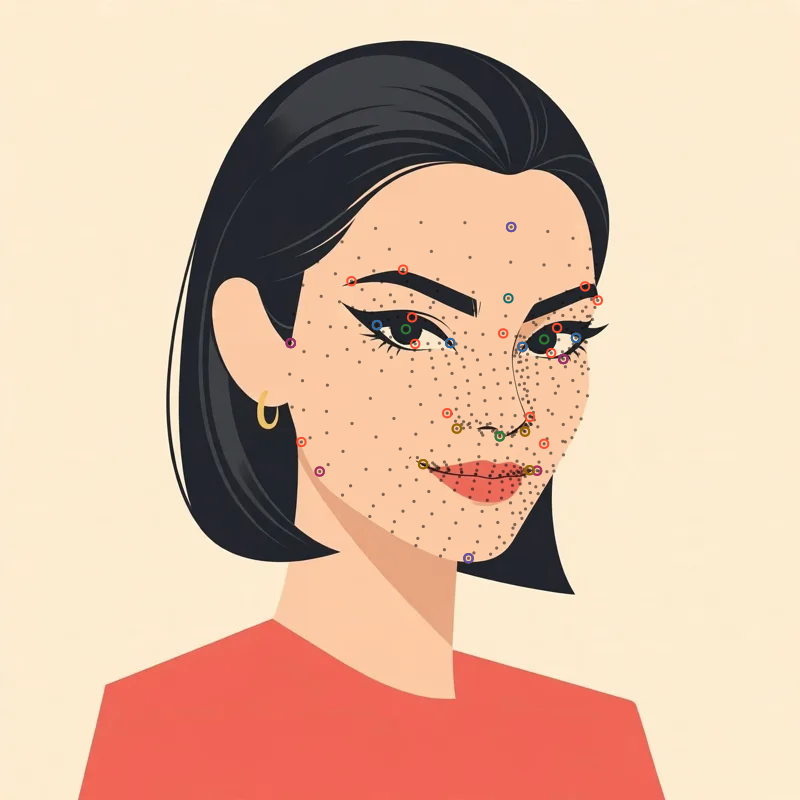
The model is MediaPipe Face Landmarker. It returns a fixed set of points in a fixed order: 468 on the face surface, plus 10 on the irises, five per eye. The face-surface points run around the jaw outline, along the brows, around each eye, down the nose and around the lips; the iris points are what make the pupil line measurable, and therefore what make the midface ratio and the interpupillary distance possible at all.
Each point has an index. Point 33 is the outer corner of one eye and 133 the inner corner of the same eye; 168 is the nasion between the brows and 152 the chin; 234 and 454 are the cheek edges at eye level. The order is part of the model rather than something this site chose, so index 33 is the same point on every face the model sees.
Why every page prints its indices
A ratio without its inputs cannot be checked. If a page says a face is 1.226 times as long as it is wide, the only way to verify that claim is to know which two distances were divided and to be able to look at where those points sit. So each measurement page on this site prints the indices next to the value it produced, and this page is the index of that index.
The same logic is why the exports here are definitions rather than results. This page has no photo, so it has no measured values to export; what it can hand over is the table — which points, which reference, which band, which default weight — so the arithmetic can be reproduced somewhere else.
What the points cannot do
They are points on a flat photograph. Anything with depth is outside what they can say: the profile of the nose, the gonial angle at the jaw corner, how far the eyes sit under the brow. Pages on this site that deal with those — gonial angle, hooded eyes, hunter eyes — say so on the page rather than quietly reporting a number that looks like a measurement of depth.
The figure above is generated by running the model on one demo face, not drawn by hand, so the circled points are the points the ratios actually read. Regenerating it is a script run rather than an edit.
Landmark questions
How many facial landmarks does the model find?
478. That is 468 points on the face surface plus 10 on the irises, five per eye. The face-surface points cover the jaw outline, the brows, the eyes, the nose and the lips; the iris points are what make the pupil line and the interpupillary distance measurable.
What do the landmark numbers mean?
They are indices into the model's fixed output order — point 33 is the outer corner of one eye, 133 the inner corner of the same eye, 168 the nasion between the brows, 152 the chin, and so on. The order is part of the model, not something this site chose, so the same index refers to the same point on every face.
Why print the indices at all?
Because a ratio without its inputs cannot be checked. If a page says your face is 1.226 times as long as it is wide, the only way to verify that is to know it divided point 10 to 152 by point 234 to 454 and to be able to look at where those points are. Every ratio on this site prints its indices for that reason.
Can I use these landmarks for something else?
The definitions on this page are exported as CSV and JSON so they can be reused, and the model itself is served from this site's own folder. What the points are good for is geometry: distances, ratios and angles in the picture plane. What they are not good for is anything with depth — the profile of the nose, the gonial angle, how far the eyes sit under the brow.
Related pages
- Methodology — the model, the eight formulas, the weights, the browsers tested.
- Facial proportions — six of the eight ratios, measured from a photo.
- The measured test — all eight rows with the indices printed beside them.