Jawline — jaw width against face width, measured
One photo, four landmarks, two numbers: how wide the jaw is relative to the cheekbones, and how sharply the outline turns at each jaw corner. The first has a stated band; the second is printed and not scored.
The landmark model ships with the page and runs on WebAssembly in your browser. No account, no upload. The page's security policy names the few origins it may reach — its own folder, the page counter, and Google's ad hosts — and the browser refuses every other one. An upload has no route off this device that this site put there.
1 · Your photo
Choose a photo. The engine loads when you press Analyze.
2 · What the test saw
3 · The ratio
Nothing measured yet.
4 · The corner angle
Nothing measured yet.
Jawline: what can be measured from the front
The jawline people talk about is the lower edge of the mandible plus everything soft sitting on top of it. Only part of that is visible in a photograph, and only part of that part is geometry rather than lighting. This page measures the part that is geometry: where the two jaw corners sit, how far apart they are, how wide the face is at the cheekbones, and how sharply the outline turns at each corner.
It does not measure definition, and it does not measure the gonial angle. Both of those are stated as limits below rather than quietly turned into numbers, because a made-up number is worse than a missing one.
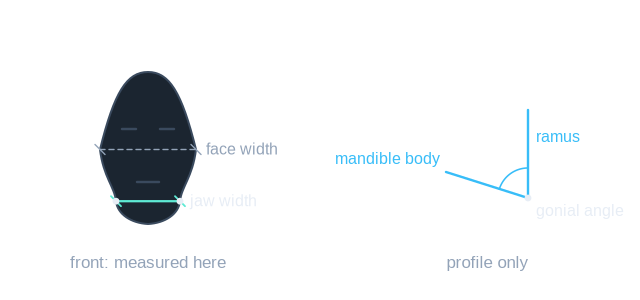
How this page measures the jaw
Four landmarks out of the 478. The jaw corners are 172 and 397; the widest points of the face are 234 and 454. Jaw width is the distance between the first pair, face width the distance between the second, and the ratio is the first divided by the second. A ratio of 0.76 means the jaw is 76% as wide as the widest part of the face.
Dividing by face width is what makes the number comparable between photos at different sizes: a close-up and a wide shot of the same head give the same ratio, while the raw pixel distances differ. It does not make the number comparable between different lenses, which is a separate problem and a worse one — see below.
The corner angle uses three points per side: the jaw corner, the next outline point towards the chin (136 or 365), and the next one towards the ear (58 or 288). The angle between those two directions describes how much the outline turns at the corner. A rounded jaw turns gently and reads closer to 180°; an angular one turns more and reads lower.
That angle is printed per side, with the difference between the two. It is not scored against a band, because there is no published reference value for a front-view corner angle — and the corner is soft tissue, so it moves with clenching, weight and light. What it is good for is comparing the same face across photos taken the same way.
What a front photo cannot measure
- Definition. The visible edge between jaw and neck is a shadow. Light from above carves it; flat light removes it. Two photos of the same jaw can differ by more than two different jaws do.
- The gonial angle. It is the angle between the ramus and the mandible body, both of which are only visible in profile or on a radiograph. Any site that quotes a gonial angle from a front photo is quoting something it did not measure.
- Bone versus soft tissue. A wide-looking jaw can be bone, masseter, or fat distribution, and a photograph cannot separate them. That separation needs imaging or a clinician, not a web page.
- Whether anything you do changes it. This page measures one photograph at one moment. It cannot tell you whether an exercise, a posture change or anything else has an effect over months — that needs a controlled comparison, not a before-and-after selfie.
What actually moves the number in a photo
In rough order of how much each one usually contributes:
- Lens and distance. A phone held at arm's length uses a wide lens; perspective pushes the ears and jaw back and enlarges the centre of the face, so the jaw reads narrower than it is. Step back and zoom, and the same head reads wider.
- Camera height. Above eye level exaggerates the forehead and shrinks the jaw; below eye level does the reverse. Eye level is the only reading worth comparing.
- Chin position. Tucking the chin gathers soft tissue under the jaw and flattens the corner; lifting it stretches the neck and sharpens the outline without changing the bone.
- Clenching. Pulls the masseter and widens the lower face slightly in that frame. It is a real change in the photograph and a temporary one in the face.
- Facial hair. A beard that extends past the jaw line is followed by the model as if it were jaw, so the corner point moves outwards.
- Lighting. Does not move the landmarks much, but moves everything a person sees, which is why a photo can look like a different jawline with the same measurements.
The 0.76 band, and what it is not
The ratio is scored against 0.76 with a band of ±0.10. That figure comes from the classical proportion tradition — the same family of conventions that gives the even thirds and fifths used elsewhere on this site — and not from any study of what people find attractive. It is a reference point, not a target, and a jaw outside it is not a flaw: it is a jaw that differs from one convention.
Because the band is this page's choice, the full test lets you widen or tighten every band at once and watch the composite move while the measured values stay put. That control exists precisely so the band cannot be mistaken for a fact about the face.
Related pages
- Attractiveness test — all eight ratios, including this one, with the composite and the weights.
- Canthal tilt — the eye angle, per eye, in degrees.
- Norwood scale — the eight stages of male pattern hair loss, and why a photo cannot stage you.
- About this site — what the measurement claims, and what it does not.