Hooded eyes — the fold, four look-alikes, and what a photo can measure
Hooding is a fold of skin, and a fold is the one thing a landmark model cannot find. So this page does two things: it tells the fold apart from the four things it is usually confused with, and it measures the two numbers a photo can honestly give you.
The 478-point mesh puts points on the edge of the lid and inside the eye. It has no point on the crease, because a crease is a shading pattern in skin rather than a boundary between two things. What follows measures where the visible lid edge sits on the iris — a real number you can check on your own photo — and says nothing about the fold. Any tool that reports "hooded" from a face mesh is reading pixels above the lid and guessing, with a number attached to the guess.
1 · Your photo
Choose a photo. The engine loads when you press Analyze.
2 · What the test saw
3 · How much of the iris the lid covers
Nothing measured yet.
4 · The rest of the face
Canthal tilt — the angle of the eye opening — is one of the eight ratios in the full test, and it comes from the same four corner points. The other seven, and the weights you can move yourself, are on the main page.
Open the full attractiveness testWhat the word means
Hooded eyes are eyes where a fold of skin from the brow area hangs over the crease, so that the crease is partly or completely hidden and, with the eye open, the skin sits close to the lashes. The word comes from makeup and styling writing, which needed a short way to describe the eye that has to be made up differently — shadow placed higher, liner kept thin, the crease drawn back in. It is a description of an appearance, not a diagnosis, and it says nothing about how well the eye works.
Two things follow from that origin. The first is that the term has no agreed boundary: "hooded" covers everything from a crease that is visible only at the inner end to a fold that rests on the lashes, and the same eye moves between those two descriptions depending on how wide it is open and where the light is coming from. The second is that the word is used for two different histories — a fold that has been there since childhood, which is simply how that face is built, and a fold that has deepened with age as the skin of the lid lost elasticity. Photographs cannot tell those apart either; only a photograph from ten years earlier can.
The nearest clinical terms are worth knowing because they are what people arrive at after searching. Dermatochalasis is excess skin of the upper lid, usually age-related, which can hang over the lashes and in pronounced cases intrude on the upper field of view. Ptosis is a low lid margin — the edge of the lid itself sits lower than it should, so it covers more of the iris and can reach the pupil. Neither is the same thing as hooding: in a hooded eye the margin can sit in a perfectly normal position while the fold above it is deep.
The four look-alikes
Most of the confusion about hooded eyes comes from four other things described with the same vocabulary, plus the clinical term for the age-related version of the same appearance. They are separable by eye, without any measurement, if you know what to look at.
| Label | What is actually happening | How it differs from hooding |
|---|---|---|
| Deep-set | the eye sits further back under a prominent brow bone | the lid area is in shadow and looks small, but the crease is usually still visible, especially looking down; from the side the eye clearly sits behind the brow |
| Ptosis | the lid margin itself is low, covering more of the iris | it is the edge that is low, not the skin; often one side only, and the crease can be fully visible above a dropped margin |
| Epicanthic fold | a fold of skin at the inner corner, over the caruncle | it changes the inner corner rather than the crease, and it commonly coexists with hooding instead of replacing it |
| Monolid | there is no crease at all; the lid skin runs from brow to lashes | there is nothing to be covered — a monolid is not a hidden crease but the absence of one |
| Dermatochalasis | loose upper lid skin, often with puffiness | this is the age-related version of the same appearance, and the only one on this list that can interfere with vision |
The distinction that matters most in practice is hooding against ptosis, because they look alike in a photograph and are completely different things: one is skin, the other is the lid's own position. If a lid has dropped recently, has dropped unevenly between the two eyes, or does not close fully, that is a medical question and not a shape question.
Why no app can see the crease
The face mesh that every browser-based face tool uses has 478 points: 468 across the face surface and ten inside the eyes, five per iris. The eyelid points are the ones that matter here. Point 159 sits at the centre of the upper lid edge on one side and 386 on the other; 145 and 374 sit on the lower lid edge; 33, 133, 263 and 362 are the four corners. Every one of those sits on the boundary between the lid and the eyeball.
The crease is not on that boundary. It is a fold in the skin above the lid, and the mesh has nothing there — the nearest points are on the brow. That is not an oversight in the model; it is what a landmark model is. It finds edges and corners that look the same on every face, and a crease is a shading pattern whose position changes with the light, the age of the skin, and whether the eye is open.
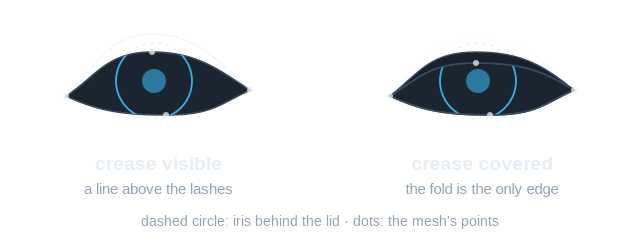
There is a second consequence, and it is the reason the numbers on this page are worded the way they are. On a hooded eye, the visible edge of the lid is the edge of the fold. The model finds that edge perfectly well — it is a strong, high-contrast boundary — but the point it returns is the fold, not the margin underneath it. So the same number can mean two different things on two different faces, and nothing in the number says which.
What this page measures instead
Two numbers per eye, both from points that exist:
- Iris covered. The share of the iris's height that sits above the visible upper lid edge. If the edge sits 2 mm below the top of a 12 mm iris, that is 17%.
- Opening ÷ iris. The height of the eye opening — lid edge to lid edge at the centre — divided by the iris diameter. It says how open the eye is, in units of the iris, so it does not depend on how big the photo is.
The arithmetic is done across the iris rather than up and down it, and that is not a shortcut. The iris is a circle, so its horizontal width is its diameter; its vertical extent is exactly what the lid cuts off. Measuring the diameter vertically would take the lid's own shadow for the edge of the iris, and every coverage figure would come out too large. The page takes the width as the diameter and measures the vertical position of the lid against it.
For a reference point: the upper lid margin normally rests 1–2 mm below the top of the iris, which on a 12 mm iris is 8–17% covered. A second surgical description of the same resting position puts it at 2–3 mm, or 17–25%. That is not a small disagreement — it is a factor of three — and it is the reason the band is printed rather than scored. Nothing on this page turns the number into a verdict about the eye.
This page is not part of the eight-ratio composite on the main test. It could not be: there is no published reference range to score against, and inventing one would produce a precise-looking number with nothing behind it. The measurement is printed, and the judgement is left where it belongs.
What moves the number
More than hooding does, in most photos. In rough order of size:
- Expression. The largest factor by a wide margin. A smile raises the lower lid and brings the upper lid down; a face photographed mid-laugh can read ten points higher than the same face at rest. This is not a small correction — it is usually bigger than the difference between a hooded eye and an open one.
- Gaze direction. Looking slightly down rotates the eyeball down and lets more lid cover the iris; looking up does the opposite. A phone held below the face produces the "looking up" case without the person noticing.
- Camera height and head pitch. Above the eye line compresses the opening and reads as more coverage; below it does the reverse.
- Makeup. Liner along the upper lash line, shadow above the crease, and false lashes all sit exactly where the lid edge is being detected. The point follows the darkest edge in the region, which is now the liner.
- Brow position. Raised brows stretch the lid upward and reduce the reading; a relaxed or furrowed brow increases it.
- Lenses. A coloured contact lens is a different iris edge, and a large one covers sclera the model expects to see.
- Age and swelling. The one factor here that is a real change in the eye rather than a change in the photo.
The practical consequence: this number is worth comparing against itself, on the same face, with the same camera position, the same light, and the same expression. Comparing it against a stranger's, or against a stock photo of an eye, measures two photographs.
One limitation of the denominator, since it is doing half the work. The iris ring is a fit, not an outline the model traces: the five points inside each eye are placed on an assumed iris circle, and on a narrow eye or one that is partly closed the fitted circle can come out a few per cent wider than the iris you can see in the photo. A wider denominator makes the coverage figure slightly smaller. The direction of the error is at least known, and it is one more reason to read the number against itself rather than against the band.
Three checks you can do in a mirror
None of these need a photo, and all three are more informative than a number for the question "are my eyes hooded":
- Look straight ahead with a neutral brow. Is there a line between the lashes and the brow? If a crease runs the whole width, the eye is not hooded. If it appears only at the inner or the outer end and disappears in the middle, it is partly hooded. If there is no line anywhere, that is a monolid — the lid skin runs from lashes to brow in one surface.
- Lift the skin above the brow with a fingertip. If a crease appears that you could not see a moment ago, the fold was sitting on top of it. This is the single clearest test, because it separates "no crease" from "crease hidden".
- Look down, then up, without moving your head. Hooding increases when the eye rotates down, because more of the lid's surface is exposed. A deep-set eye looks much the same in both positions, which is what makes the two separable.
What the number is good for
Two uses, both narrow. The first is asymmetry: the difference between your two eyes on one photo is a real reading, and it is common for one lid to sit lower than the other by enough to see. The second is a record: a fixed setup, one photo a month, and the change over a year is visible in a way that a single measurement never is.
It is not good for deciding between hooding and ptosis, because that is a question about which structure moved, and the answer is in the mirror and in whether the lid margin or the skin above it is the thing that changed. And it is not a diagnosis. If a lid has dropped quickly, dropped on one side only, does not close completely, or is getting in the way of your vision, that is a conversation with a doctor and not a measurement from a web page.
One practical note, since most people asking this question are asking it about makeup: the usual advice — place shadow above where the crease would be, so it is visible with the eye open; keep liner thin and tight to the lashes; curl lashes rather than weighing them down — all follows from the same fact, which is that the visible lid area is smaller than it looks with the eye closed. This page does not test any of that advice.
Hooded eye questions
What are hooded eyes?
Eyes where a fold of skin from the brow area hangs over the crease, so the crease is partly or fully hidden and the skin sits close to the lashes when the eye is open. It is a descriptive term from makeup writing rather than a diagnosis.
How can I tell whether my eyes are hooded?
Face a mirror with a neutral brow and look straight ahead. A crease that runs the whole way means not hooded; a crease that appears only at one end means partly hooded; no crease at all means a monolid. Lifting the skin above the brow brings out a crease that the fold was covering, which settles the question in a second.
What is the difference between hooded eyes and deep-set eyes?
Deep-set eyes sit further back under a prominent brow, so the lid falls into shadow and looks small, but the crease is usually still visible — most clearly when looking down. Hooding is about the skin above the crease, not the depth of the eye. The two often occur together, which is why the words get used interchangeably.
Are hooded eyes the same as ptosis?
No. Hooding is loose skin above the lid; ptosis is the lid margin itself sitting lower than normal. A hooded eye can have a perfectly normal margin under a deep fold, and a ptotic eye can have a fully visible crease above a dropped margin. A lid that has dropped recently, unevenly, or far enough to affect vision is a reason to see a doctor.
Can an app tell me whether I have hooded eyes?
Not from landmarks. The mesh has points on the lid edge and inside the eye, and none on the crease, because a crease is a shading pattern rather than a boundary. A tool that reports "hooded" is reading pixels above the lid and guessing, and the guess moves with lighting, eyeshadow and camera angle. What the mesh can do is measure where the visible lid edge sits on the iris, which is what this page prints.
Do hooded eyes make a face look tired or older?
That is a claim about how photographs are read, not a finding, and this page does not test it. Eyelid skin does loosen with age, so a deep fold is a cue people learn to associate with age; but hooding is also common from birth, and the same fold reads differently under different lighting. Nothing here supports a statement about how a face is perceived.
Can hooded eyes be changed?
Surgery can remove the excess skin, and upper blepharoplasty is a common operation for exactly that; makeup can move the apparent crease for a day. This page takes no position on either and does not measure the result of one. If the fold is interfering with your field of view, that is a medical conversation rather than a cosmetic one.
Does hooding get worse with age?
Usually somewhat, because the skin of the upper lid loses elasticity and the tissue beneath settles. The change is slow and uneven between the two sides, which is why one photograph cannot tell you whether a fold is longstanding or recent. A fixed setup and one photo a year is the only way to see it rather than infer it.
Related pages
- Canthal tilt — the angle of the eye opening, per eye, from the same four corner points.
- Hunter eyes — the same eye area under a forum vocabulary: four readings, two claims that need a profile view.
- Attractiveness test — all eight ratios, the composite, and the weights you can move yourself.
- Face shapes — the six standard outlines as two ratios, and where the ranges overlap.
- Jawline — jaw width against cheekbone width, with the pixel spans printed.
- Color analysis — the other measurement the camera decides: a white-balance slider that moves the season without moving the face.
- About this site — what the measurements claim and, more importantly, what they do not.